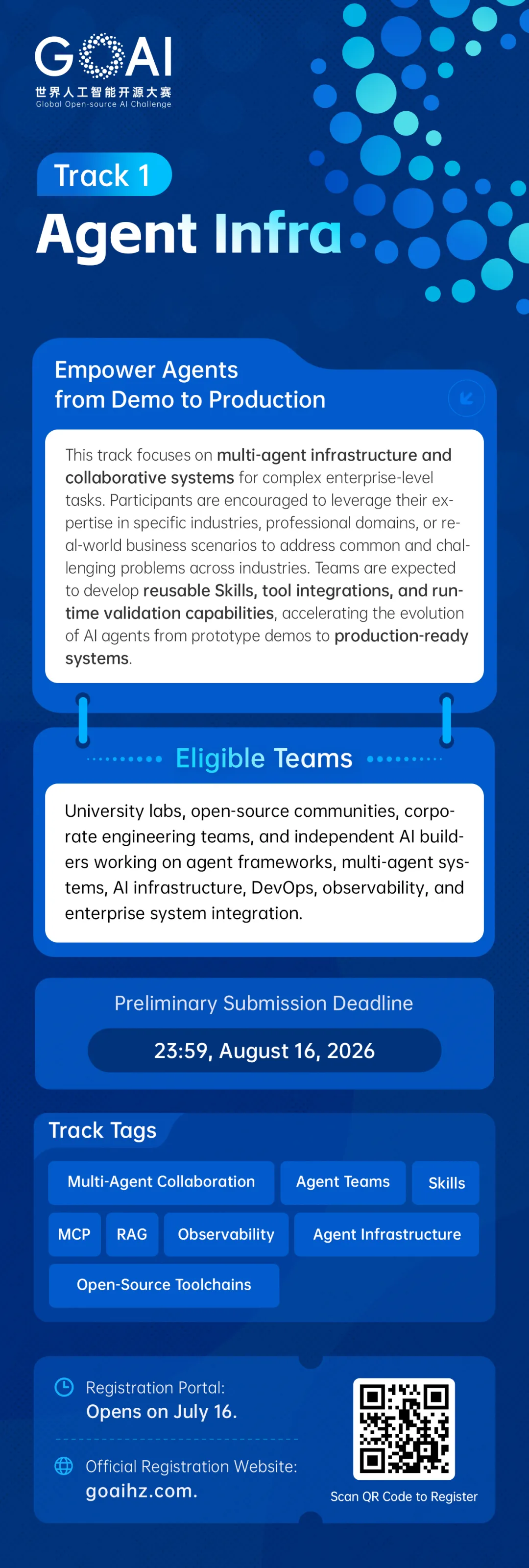
2026 Global Open-source AI Challenge (GOAI)「Agent Infra」Track Officially Launched
Empowering Multi-Agent Systems from Demo to Production
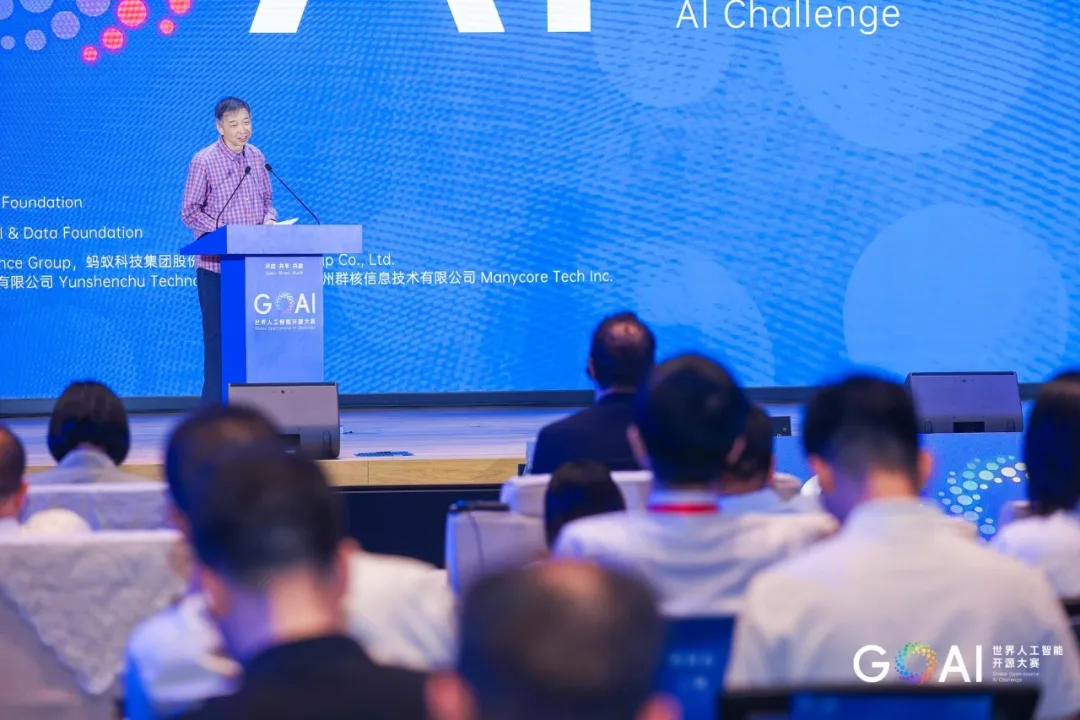
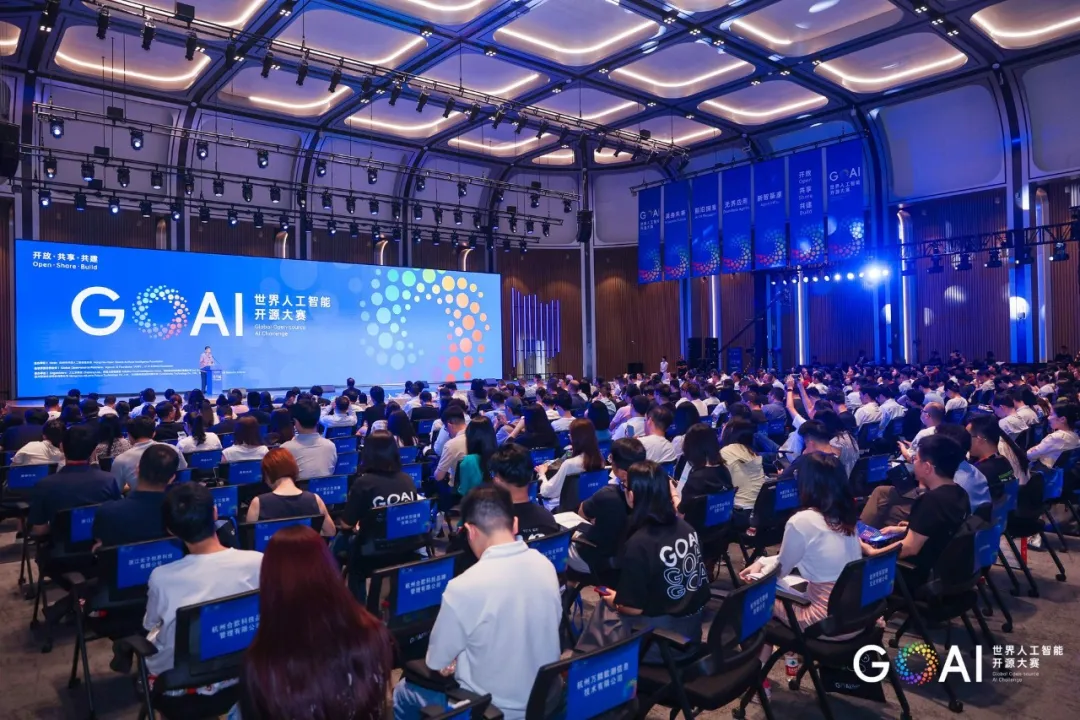
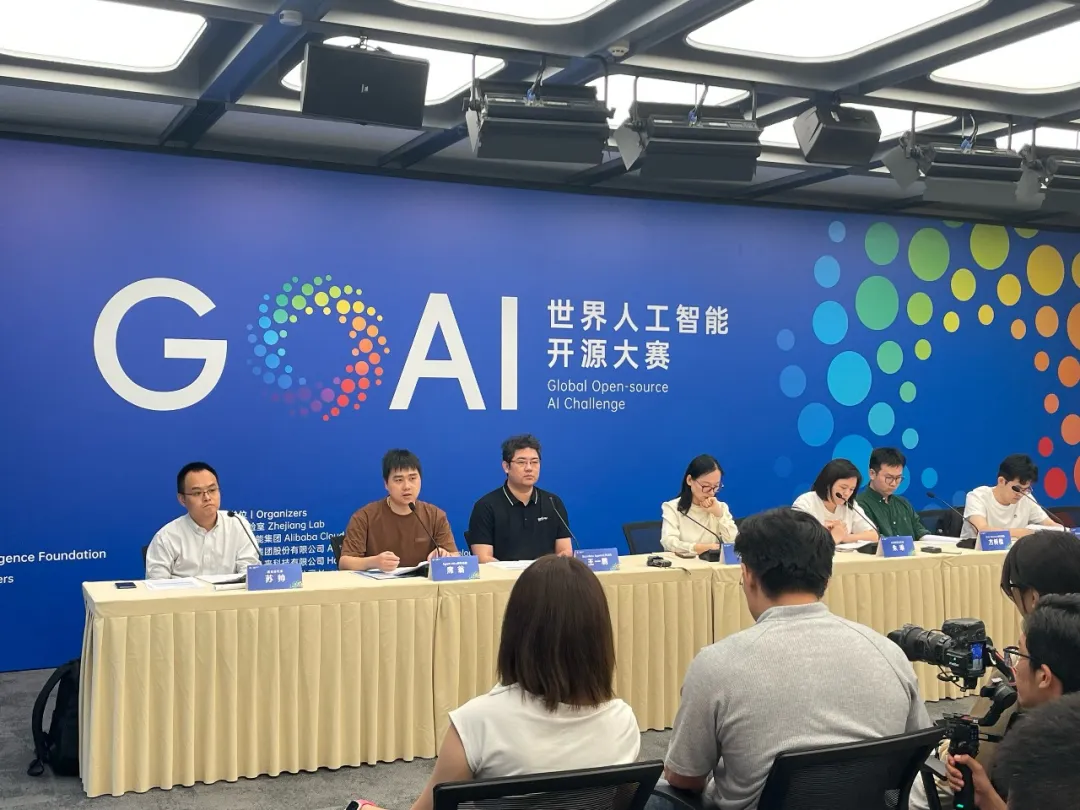
On July 21, 2026, the first Global Open-source AI Challenge (GOAI) officially kicked off at the Hangzhou Cloud Valley Center. As one of the core competition tracks, the "Agent Infra" Track calls for enterprise-grade multi-agent system solutions that are operable, verifiable and auditable. It aims to discover the developers and teams capable of enabling seamless collaboration among multiple agents and delivering robust performance in production environments.
At the launch ceremony, guests from academia, industry, and Open-source communities reached a consensus: as large models mature, the competition in AI agents is shifting from "standalone intelligence" to "system engineering". The success of this shift largely hinges on the maturity of underlying infrastructure. The launch of the "Agent Infra" Track directly addresses this core industry challenge.
Track Background: Why the Agent Infra Track Matters
Over the past year, countless standalone agent applications have emerged across the industry. Equipped with a powerful large model and several tool calls, such agents can complete single conversational tasks with ease. Agents are rapidly evolving from simple Q&A tools into new production factors within enterprises entering production environment.
However, deploying multiple agents into real-world workflows at the same time brings far more complex challenges than merely "making models smarter": How can multiple agents divide labor and collaborate? Can the entire task lifecycle be fully traced? What happens when a tool call fails? Can high-risk operations be reviewed and rolled back? Troubleshooting an operational & maintenance failure requires coordination across alert analysis, root cause identification, solution formulation, change execution and result validation. A financial claims processing workflow demands collaboration between specialists responsible for document review, risk control rules and fund disbursement. No single agent, no matter how advanced it is, can replicate the coordination of a "professional team".

These challenges point to the same industry demand: enterprises no longer require isolated agent capabilities, but a set of industrialized, governable and trustworthy multi-agent infrastructure. This case mirrors the relationship between virtualization and cloud computing, or operating systems and mobile Internet: the maturity of foundational infrastructure sets the scalability ceiling for upper-layer applications. This forms the core logic behind the Agent Infra Track. The real bottleneck preventing agents from Demo to Production is not the performance limit of individual agents, but the underlying infrastructure supporting coordinated multi-agent operation.
Track Positioning: Focus on Multi-Agent Collaborative Infrastructure
Participating teams in the Agent Infra Track are required to design a closed-loop task workflow consisting of no fewer than 3 agents with distinct functional roles, built around real business scenarios. Submissions must fully demonstrate the capabilities including task decomposition, context transmission, tool invocation, result verification, execution record archiving and security auditing. All core capabilities shall be encapsulated into reusable Skills.
Unlike generic agent applications, this track places heavy emphasis on system engineering proficiency. Evaluation covers not just one-off functional execution, but a full suite of engineering capabilities that sustain stable multi-agent operation: multi-agent collaboration, industrialized Skill development, stable integration with tools and enterprise systems, alongside MCP, RAG, observability frameworks, security approval, rollback and auditing mechanisms. Runtime logs, Traces, metrics and execution records serve as key evidence to assess whether a system is trustworthy and reproducible.
In short, this track does not judge submissions by "how intelligent a single agent is", but by "how well teams can orchestrate multiple agents into a governable, observable and evolvable production-grade system".
Core Requirements: Industrialization and Reusability of Skills
This track prioritizes "reusability" over "one-off". The submissions must deliver a closed-loop solution with a minimum of 3 functionally differentiated agents for enterprise scenarios, with core capabilities encapsulated into reusable Skills instead of one-time scripts or single-show demos.
To be more specific, submissions are expected to prominently showcase the following competencies:
-
Completion of complex tasks via multi-agent collaboration
-
Reusable and industrially encapsulated Skills
-
Stable integration with external tools, systems or cloud products
-
Context management and archiving of execution evidence
-
Security boundaries, approval workflows, rollback and auditing mechanisms
-
Open-source roadmap and long-term developmental value of the submissions
This set of requirements reflects the prevailing trend of Agent industrialization: really valuable agent systems should operate sustainably like well-trained human teams, with reusable capabilities transferable across diverse scenarios, rather than limited to a single impressive demo.
Eligibility: Real-World Scenarios & Closed-Loop Capabilities
The track provides reference use cases including zero-human O&M, intelligent customer service, collaborative software development, financial risk control and automated claims processing, with no restrictions on industry verticals. Teams are encouraged to build solutions based on their familiar real business domains.
I. Rooted in authentic real-world scenarios that require cross-role collaboration, rather than basic Q&A or single-round content generation.
II. Closed task loops: the system can generate recommendations, trigger tool-driven execution, and validate final outcomes.
III. Reusable core capabilities: extractable Skills, tool interfaces, data standards or collaborative workflows applicable to analogous scenarios.
Special track reminder: a streamlined, fully verified "small closed-loop solution" grounded in real scenarios often outperforms bloated, untested all-in-one "large platforms". This distinguishes the Agent Infra Track from conventional AI application contests, guided by the principles of pragmatism, verifiability and real-world deployability.
Evaluation: Balancing Scenario Value, Collaboration and Engineering
To align with its core orientation of balancing scenario value, collaborative capacity and engineering quality, the track adopts five evaluation dimensions:
-
Scenario Value & Industry Reproducibility: 25%
-
Multi-Agent Collaboration & Autonomous Closed-Loop Execution: 25%
-
Industrialized Skills & Ecosystem Reusability: 25%
-
Engineering Deployment, Runtime Validation & Security Auditing: 20%
-
Openness & Open-source Contribution: 5%
The weighting structure demonstrates that the track does not reward "technical gimmicks". Real business value, inter-agent coordination and production-ready engineering standards carry equal weight, guiding teams to build solutions with both industrial significance and verified operational reliability.
Schedule & Awards: Progressive Path from Preliminary to Final Rounds
The competition registration opened on July 15. Participating teams may register via the official website, and the deadline for preliminary round submissions is August 16; the list of semi-final shortlisted teams will be released on August 24, with the Top 30 teams advancing to the semi-finals; the deadline for semi-final submissions is September 3; the final shortlist will be announced on September 10, and the Top 15 teams will qualify for the finals; offline final defenses and demonstrations will be held on September 22; the award ceremony, project showcase and ecosystem matchmaking will take place on GOAI DAY, September 23.
This track features a clear progressive path from the preliminary round to the final round, with escalating requirements for "runnability" at each stage. Teams are not required to submit runnable codes in the preliminary round; they may illustrate scenarios, architecture, Agent role allocation, Skill design and implementation plans through project briefs and solution PPTs. Upon advancing to the semi-finals, teams must submit executable AgentTeams code packages and runnable Demos. For the final round, teams are additionally required to provide the final code repository or other verifiable engineering materials, as well as complete on-site presentations and defenses.
In terms of awards, the cash prizes for the track's champion, first runner-up and second runner-up are RMB 500,000.00, RMB 300,000.00 and RMB 100,000.00 respectively; outstanding projects will also be eligible to compete for the RMB 1,000,000.00 overall GOAI Grand Prize.
Closing Remarks: Co-Creating Infrastructure Standards for the Multi-Agent Era with Global Developers
Bridging the gap between "a single agent completing isolated tasks" and "a group of agents sustainably undertaking full business workflows" requires a complete industrial engineering framework. The Agent Infra Track seeks developers and teams capable of building agent systems that really collaborate, execute and pass rigorous validation.
The long-term vision of the Agent Infra Track is to transform agents from external auxiliary tools into native built-in capabilities for enterprises. Leveraging the GOAI platform, we aim to collaborate with global developers to define universal infrastructure standards for the multi-agent era, accelerate the transition of agent technology from laboratory demos to large-scale industrial adoption across all sectors, and empower China's Open-source community to take the lead in setting global standards in this emerging field.
Track 1: Agent Infra DingTalk Group ID: 186080014742

Competition Registration QR Code

GOAI Assistant
 Registration for the competition is now open. We welcome you to sign up:
https://www.goaihz.com/tracks?track=infra
Registration for the competition is now open. We welcome you to sign up:
https://www.goaihz.com/tracks?track=infra